
bloodstain pattern analysis
Blood can be powerful evidence.
But bloodstain pattern evidence is often treated as if it can prove what happened.
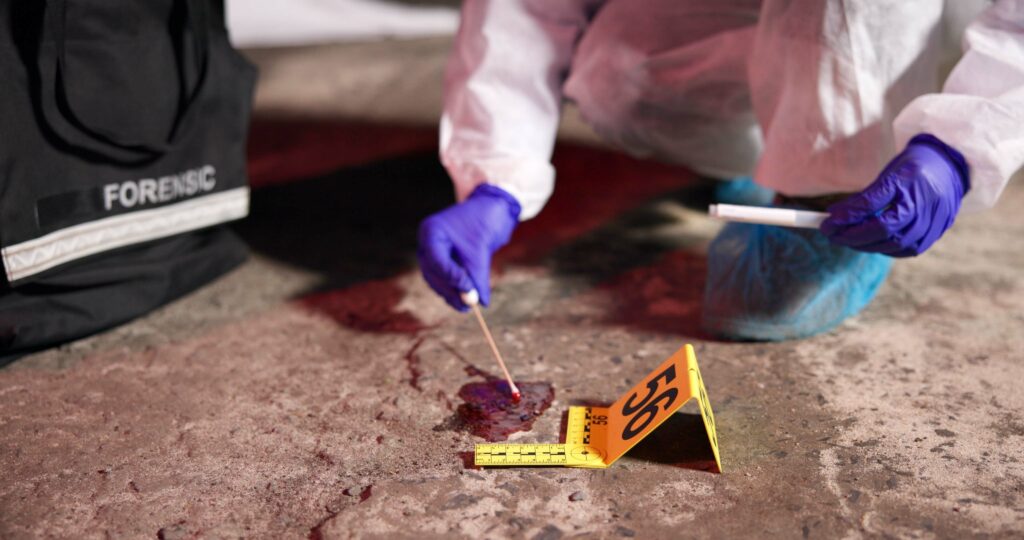
Bloodstain pattern analysis (BPA) is the forensic examination of bloodstains to assist in interpreting how blood was deposited. It draws on principles of physics (alongside biology and careful crime scene evaluation) to assess bloodstain size, shape, distribution and directionality, and to evaluate issues such as mechanism, movement, and whether competing accounts are consistent with the physical evidence.
Roebuck Forensics provides independent bloodstain pattern analysis review for criminal lawyers across Australia and New Zealand, including matters where BPA evidence is central to the prosecution case or defence case strategy.
Blood can be powerful evidence.
But bloodstain pattern evidence is often treated as if it can prove what happened.
Bloodstain pattern analysis (BPA) is the forensic examination of bloodstains to assist in interpreting how blood was deposited. It draws on principles of physics (alongside biology and careful crime scene evaluation) to assess bloodstain size, shape, distribution and directionality, and to evaluate issues such as mechanism, movement, and whether competing accounts are consistent with the physical evidence.
Roebuck Forensics provides independent bloodstain pattern analysis review for criminal lawyers across Australia and New Zealand, including matters where BPA evidence is central to the prosecution case or defence case strategy.
Early, strategic advice is often informal and does not require a full report
What is bloodstain pattern analysis?
Bloodstain pattern analysis (BPA) involves the assessment of bloodstains to consider factors such as:
- blood origin and distribution
- directionality and bloodletting dynamics
- potential positions of persons within the scene
- movement through the scene after bleeding began
- whether an account is consistent with the physical evidence
- whether there is evidence of disturbance, transfer, or staging
Unlike identification evidence, BPA is not about “whose blood is it?” It is about what the bloodstain pattern may indicate about what occurred, and what alternative explanations remain viable.
Key bloodstain pattern terms
Bloodstain pattern analysis frequently involves terminology that sounds definitive. In practice, these terms describe features, not conclusions.
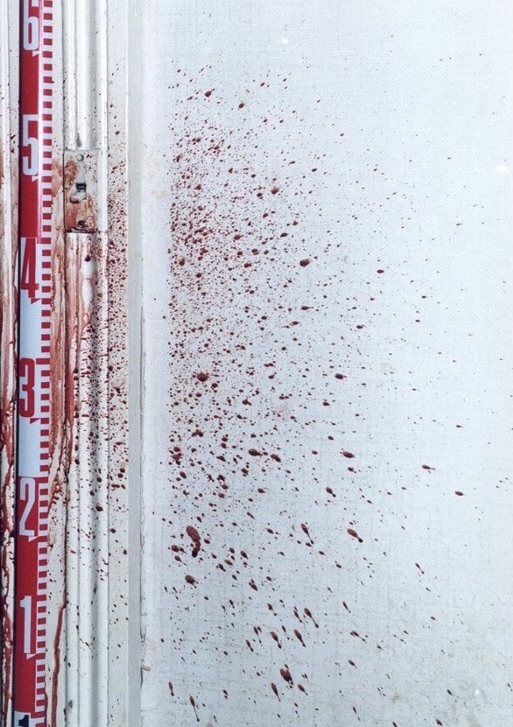
Impact spatter describes bloodstains created when force is applied to a blood source, causing droplets to disperse.
Impact spatter may occur during assaults, but interpretation must consider:
- the nature of the blood source and surface
- the environment and disturbance
- whether transfer or movement may explain similar staining
- the limitations of available documentation (photography, scale, context)
Cast-off describes blood being flung from a moving blood-bearing object.
Cast-off patterns can sometimes assist in considering repeated motion, but they are not always present, and their interpretation can be context dependent.
Transfer stains occur when a bloodied surface contacts another surface.
Smears and wipes may occur where wet blood is disturbed. These patterns can be highly relevant in cases involving movement, contact events, or scene alteration.
Passive stains occur under gravity alone.
Passive bloodstain patterns can assist in evaluating whether an injured person was stationary or moving, whether bleeding continued in one location, and whether the distribution of stains fits competing accounts.
Case example: when “impact spatter” becomes the wrong shortcut
Consider a scenario of a kind that arises frequently in practice.
A complainant is found injured inside a residence.
The allegation is that the assault occurred in one room during a confrontation.
Crime scene photographs show scattered small bloodstains on a nearby wall.
The police report may describe the blood staining as “impact spatter”, and the room may then be treated as the confirmed assault location.
But an independent bloodstain pattern analysis review may require further questions to be addressed, including:
Are the wall stains actually consistent with impact, or could they be explained by passive dripping combined with movement?
The analysis may not provide a single definitive answer – but it can clarify what the blood evidence genuinely supports, and where assumptions have been made.
Consider a scenario of a kind that arises frequently in practice.
A complainant is found injured inside a residence.
The allegation is that the assault occurred in one room during a confrontation.
Crime scene photographs show scattered small bloodstains on a nearby wall.
The police report may describe the blood staining as “impact spatter”, and the room may then be treated as the confirmed assault location.
But an independent bloodstain pattern analysis review may require further questions to be addressed, including:
Are the wall stains actually consistent with impact, or could they be explained by passive dripping combined with movement?
The analysis may not provide a single definitive answer – but it can clarify what the blood evidence genuinely supports, and where assumptions have been made.

Why Roebuck Forensics
I have worked across every part of the forensic process - from crime scenes, to laboratory interpretation, to expert witness testimony.
My focus is not simply the presence of DNA or a statistic.
It is what the evidence can actually support — in the context of the case.
Next Step
If you’d like to discuss whether the forensic evidence in your matter warrants further review:
A preliminary review can be a useful step in assessing the broad strengths and weaknesses of a particular matter. This process can also identify documentary and any further evidence requirements.
I rigorous interrogation of the evidence will uncover underlying issues and determine the most appropriate pathway towards reviewing and reporting the matter.
Certain complex matters benefit from a draft report, which can open areas for discussion with Counsel, and potentially allow for defence to approach the prosecution.
Following a thorough evaluation of the evidence, a DNA expert report will be issued in accordance with the expert witness code of conduct. The report will be suitable for submission in evidence.
Preparations with Counsel are often conducted, such that the probative value of the evidence is weighed effectively and persuasively at Voir Dire, should such a hearing be required.
Extensive preparations are generally conducted in anticipation of substantive hearing. Which may include cross examination and evidence in chief scenarios specific to the matter .
Professional Memberships



University of Technology Sydney – Industry Fellow
Australia and New Zealand Forensic Science Society
The AFS (Australian Forensic Society) was formed in 1971 to bring together scientists, police, criminalists, pathologists, and legal professionals actively involved in the field of forensic science. In 1988, the AFS recognised New Zealand members and changed its name to ANZFSS.
Australian Academy of Forensic Sciences
Chartered Society of Forensic Sciences
The Forensic Science Society was founded in 1959. Now accepting memberships globally the CSOFS is the peak professional body for forensic practitioners, academics, researchers and associated professions in the United Kingdom.
In 2014, the Society was granted a Royal Charter and became The Chartered Society of Forensic Sciences.
The CSOFS is recognised as the ‘international voice of forensic science’.
The Chartered body is committed to integrity and impartiality, aiming to provide opportunities for practitioners and academics to congregate, communicate and collaborate.
BLOODSTAIN PATTERN ANALYSIS QUESTIONS
Bloodstain pattern analysis
Bloodstain pattern analysis uses the physical properties of blood, physics (including projectile motion and fluid dynamics) and mathematics (geometry, distance and angles) to interpret bloodstains and recreate the actions that caused them.
Conducting BPA
Analysts assess the appearance, distribution, size, range, shape and spread of bloodstains to interpret the event.
Using photographs to conduct BPA
High resolution photographs can be used to conduct BPA, but the photographs must be taken in a manner that facilities interpretation.
Error rate
A study in 2023 demonstrated that on average BPA analysts incorrectly categorised bloodstains 11% of the time.
Bloodstain pattern analysis - terms
Bloodstain
A deposit of blood on a surface.
Bloodstain pattern
A grouping or distribution of bloodstains that indicates through regular or repetitive form, order, or arrangement the manner in which the pattern was deposited.
Altered stain
A bloodstain with characteristics that indicate a physical change has occurred.
Angle of impact
The acute angle (alpha), relative to the plane of a target, at which a blood drop strikes the target.
Area of origin
The space in three dimensions to which the trajectories of spatter can be utilized to determine the position of the spatter producing event.
Backspatter pattern
A bloodstain pattern resulting from blood drops which can be produced when a projectile creates an entrance wound.
Cast off pattern
A bloodstain pattern resulting from blood drops released from an object due to its motion.
Cessation pattern
A bloodstain pattern resulting from blood drops released from an object due to its abrupt deceleration.
Directionality
The characteristic of a bloodstain that indicates the direction blood was moving at the time of deposition.
Drip pattern
A bloodstain pattern resulting from a liquid that dripped into another liquid, at least one of which was blood.
Drip stain
A bloodstain resulting from a falling drop that formed due to gravity.
Drip trail
A bloodstain pattern resulting from the movement of a source of drip stains between two points.
Expiration pattern
A bloodstain pattern resulting from blood forced by airflow out of the nose, mouth, or a wound.
Flow pattern
A bloodstain pattern resulting from the movement of a volume of blood on a surface due to gravity or movement of the target.
Forward spatter pattern
A bloodstain pattern resulting from blood drops which can be produced when a projectile creates an exit wound.
Impact pattern
A bloodstain pattern resulting from an object striking liquid blood.
Perimeter stain
An altered bloodstain which consists of its edge characteristics, the central area having been partially or entirely removed.
Pool
A bloodstain resulting from an accumulation of liquid blood on a surface.
Projected pattern
A bloodstain pattern resulting from the ejection of blood under hydraulic pressure, typically from a breach in the circulatory system.
Satellite stain
A smaller bloodstain that originated during the formation of the parent stain as a result of blood impacting a surface.
Saturation stain
A bloodstain resulting from the accumulation of liquid blood in an absorbent material.
Spatter stain
A bloodstain resulting from an airborne blood drop created when external force is applied to liquid blood.
Splash pattern
A bloodstain pattern created from a large volume of liquid blood falling onto a surface.
Swipe pattern
A bloodstain pattern resulting from the transfer of blood from a blood-bearing surface onto another surface, with characteristics that indicate relative motion between the two surfaces.
Transfer stain
A bloodstain resulting from contact between a blood-bearing surface and another surface.
Void
An absence of blood in an otherwise continuous bloodstain or bloodstain pattern.
Wipe pattern
An altered bloodstain pattern resulting from an object moving through a preexisting wet bloodstain.

LAWYERS-DNA TOOLKIT
- 2 Minute DNA explainers
- 110+ scientific paper extracts
- Lab report explainers
- Scientific Guidelines